
12V or 24V Kids' Electric Car? What to Check Before Buying

Choosing between a 12V and a 24V electric ride-on car starts with your child and the space where they will play. Volts describe the battery voltage; on their own, they do not tell you the suitable age, speed or running time. If a 12V model meets your needs, there is no reason to choose 24V simply for the higher number.
When comparing kids' electric ride-on cars, start with the age and weight limits, seating capacity and controls. Then check the dimensions and the surfaces on which each vehicle may be used.
What is the difference between a 12V and a 24V ride-on car?
Voltage is one part of the electrical system. Performance also depends on the motors, transmission, battery and vehicle design. Two cars with the same voltage can therefore have different speeds, dimensions and weight limits.
For speed: check the stated figure in km/h and the available settings. If your child is learning to drive, look at how to select the low-speed setting and whether the manufacturer provides a way to restrict the higher speed.
For age suitability: read the requirements for the specific model. The idea that 12V is for younger children and 24V is for older children is not a reliable buying rule.
For example, Peg Perego's official specifications list both the John Deere Gator HPX 12V and the Polaris RZR 900 XP 24V as suitable from age 3. Sharing a starting age does not mean they have the same speed or suit every child in the same way.
When does it make sense to choose 12V or 24V?
When a 12V model suits the way your child will play
If your child meets the age and weight requirements, fits the seat properly and can use the vehicle as the manufacturer intends, check that you also have a suitable space. A 12V car that meets these needs does not need to be ruled out simply because a 24V option exists.
When a particular 24V model offers something you need
A 24V model makes sense if its actual features are a better match for your needs, such as the seat dimensions, permitted surfaces or stated seating capacity. The voltage alone does not make it a two-seater, suitable for slopes or capable of a longer running time.
Parental remote control: what to check
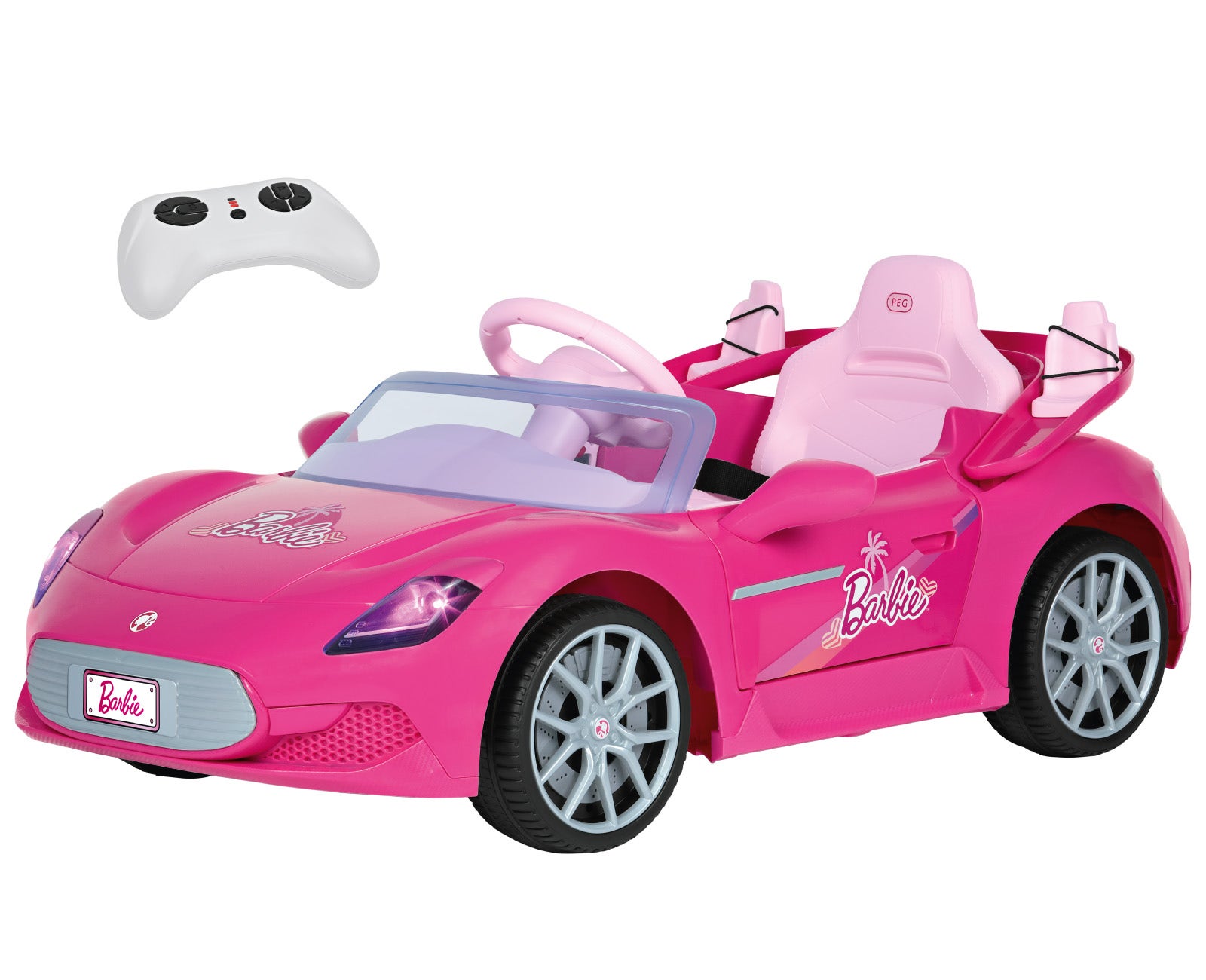
Peg Perego Barbie RC with parental remote control
Not every electric ride-on car has parental remote control. If you need it, check that it is included and read which movements it controls, how the stop function works and which controls take priority. The Peg Perego Barbie RC, for example, includes a parental remote control.
Follow the age and use requirements for each control mode described in the manual. A remote control does not override the vehicle's limits or remove the need to supervise your child closely.
Do you need an electric ride-on car for two children?
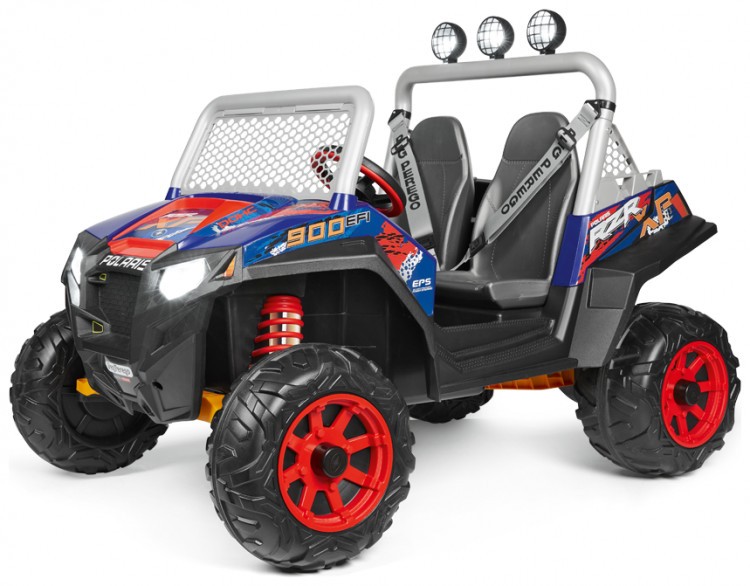
Peg Perego Polaris RZR 900 XP 24V with two seats
Look for an explicit statement that the vehicle carries two passengers, then check its total weight limit. A wide seat or two decorative headrests are not enough to establish that it is a two-seater.
The Peg Perego Polaris RZR 900 XP 24V is an example of a two-seater model for ages 3 and up. Its manual sets a maximum total load of 60 kg, including the passengers and any cargo. This is not a separate 60 kg allowance for each child.
Before choosing a vehicle for two siblings, add their weights together and check that the seating space suits them both. Each child must meet the model's requirements for use.
Play space, surfaces and storage
Measure the doorway or garden gate the car will need to pass through, as well as its storage space. If you will move it regularly, check that you can comfortably lift its weight. The play area needs room for turning, not just enough space to park the vehicle.
For grass, dirt or slopes, check the permitted surfaces and gradients for the specific model. SUV styling and large wheels are not enough to decide. Supervise its use and keep it away from traffic, steps and water, following its instructions.
How long does the battery last?
A 24V rating does not promise twice the running time of a 12V rating. Battery life depends on the particular battery, the vehicle and how it is used. Compare a stated running time together with the conditions specified by the manufacturer.
Also check the charging time, first-use instructions and battery care during longer periods of storage. Do not apply one model's charging schedule to another.
Batteries and chargers: compatibility matters
Keep the vehicle's model code and version, along with the battery and charger details. Matching voltage or a similar-looking connector is not enough to confirm that a replacement fits. Peg Perego, for example, provides separate compatibility information for lithium and lead-acid batteries.
If you need a replacement, browse the kids' ride-on batteries and chargers and check compatibility with the exact model. Do not put a 24V battery into a 12V vehicle to increase its speed. Use only a combination approved by the manufacturer.
What to note before ordering
For each car you are considering, note the age and weight limits, passenger capacity, speeds, controls, dimensions and permitted surfaces. This lets you compare two specific options against your family's needs, rather than deciding from the 12V or 24V label alone.
Sources and instructions
The examples are based on official model information, without hands-on testing. For assembly, charging and use, follow the manual that corresponds to your vehicle's version.
Peg Perego John Deere Gator HPX: official specifications and instruction manual.
Peg Perego Polaris RZR 900 XP: official specifications and instruction manual.
Peg Perego Barbie RC: official product page and instruction manual.
Peg Perego: battery and charger compatibility chart.
Related products

Moni Rancher Electric Tractor with Trailer Green

Moni Mercedes AMG G 580 12 V electric ride-on car Grey


Kikka Boo Rechargeable Ride-On Car Jumbo 12V Green Graffiti (31006050199)

Chipolino Battery operated car Formula E Porsche red ELKFEP2501R

Chipolino Battery operated car FIAT 500 white ELKFIAT25WH

Chipolino Battery operated SUV POLICE PATROL, leather seat, red ELJPPL0233R

Moni BO car Dakota yellow 3801005000357

